Templeman looked his wristwatch, a Timex that had been a gift from his wife, bought from Selfridges as a birthday gift. There were still four hours to go before he and DC Hill were to be relieved.
He was perched precariously on a stool set before a high window in an airless flat, on a hot afternoon just before Whitsun. London was emptying, as people anticipated the holiday, and crowded railway stations, or motorway junctions in their family Fords or Austins. He felt as if he and Hill were the last watchkeepers in a deserted citadel. As he leaned back; the stool, a dilapidated stinking antique which the War Office had provided, protested in a low growl of rending canvas. He cursed McCreadie for his penny-pinching ways. He shifted his weight to stimulate circulation in his legs; the sound grew more urgent. He gave up the effort and leaned toward the Zeiss binoculars. The house on the opposite side of the street in Bayswater came into view. The thought struck him that the house and the stool might have been made in the same year: he did not know which had lasted the better. He concentrated on the house; there was a dead pigeon on one second floor window ledge, no one had bothered to open the window to dislodge it.
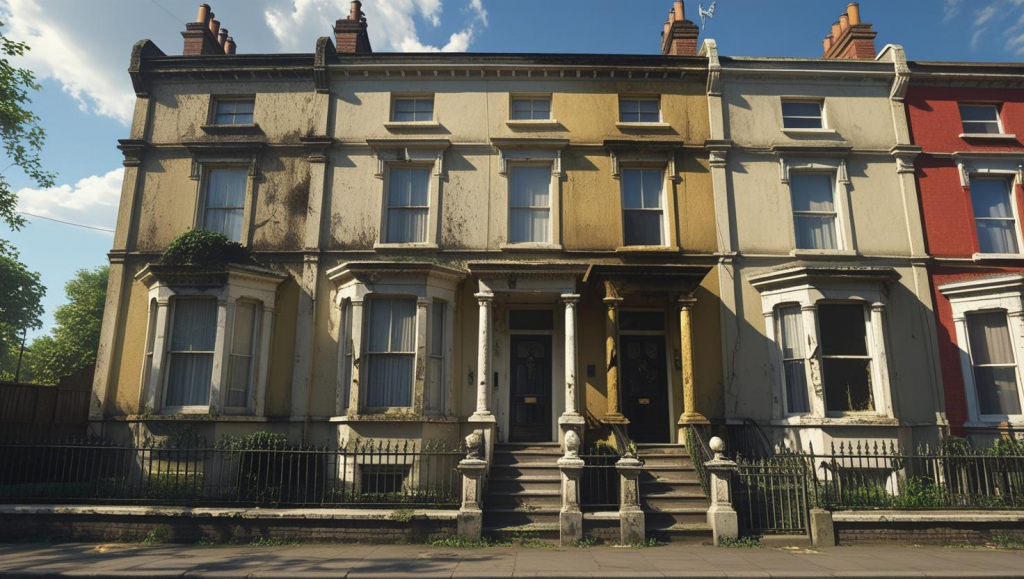
The house was divided into flats, which lay behind a coat of peeling and grimy stucco; the front steps and basement area were marked off by black rails: a procession of broken or twisted spearheads led to the front door.
There were seven flats; the lowest was a damp and mildew infested hole in the basement occupied by an unemployed actor; the ground floor and first floor each had had one flat; these were occupied by families, their children played in the street in old clothes and kicked a deflated football with mild enthusiasm; the flats above were sub divided. They had been crudely converted, cramped, and according to the officer who had visited in the guise of a plumber sent by the landlord, stank like a leaking drain. Of these four abodes, one was of interest to the Service.
Tenants came and went; some were legitimate: immigrants seeking a home, students, the dispossessed. Others were day trippers, perhaps seeking a bed for a furtive sexual encounter, or a place to hide something.
The door of the flat which was Templeman’s surveillance post opened, after a short struggle, and Hill entered, his brow beaded by sweat from the steamy café in the next street, bearing two cheese sandwiches, wrapped in napkins and thrust into the pockets of his sports jacket, and two cups of tea, in polystyrene cups, with ill-fitting lids.
“Fuck it! Fuck it!” he protested under his breath as the hot tea spilled onto his fingers. Templeman risked the dilapidated stool once more as he leaned back and turned to face Hill.
“If you can’t take the heat, keep out of Special Branch,” he said.
“Sorry guv, it’s the tea, it’s too hot.”
Templeman gingerly levered himself up. He walked across the room to a table and chair; table contained recording equipment, a prestige machine bearing the legend Telefunken, made efficiently in a German factory, adorned with large spools of tape, that was connected to a microphone in the apartment across the street. Without sitting he made a note in the log of the time he had been relieved by Hill. Hill chewed at one of the sandwiches, and gulped tea, before wiping his hands on his trousers, then he took up position, and leaned into the Zeiss binoculars. Hill had been a beat officer in Westminster before transferring; diligent in a way that most PCs were not, he had a knack for spotting people or situations that were suspicious. Wishart leaned against the table; he unwrapped his sandwich, to be presented with a slab of bright yellow cheese trapped between two slices of white bread. Deciding that he wasn’t hungry he took up the tea and sipped, its sugared warmth filling his mouth.
The men exchanged little by way of conversation, surveillance work was dull, often fruitless, but had to be carried out in an exacting fashion. Templeman looked through the log from the previous shifts. On the previous afternoon there was an entry noted at 2.45pm; a male, white, about six foot tall, clean shaven and blond, of muscular build, had approached the house, and rung the bell of one of the flats. The surveillance officer had not been able to make out which flat the male had rung for. The man had waited five minutes, then departed, heading in the direction of Bayswater Underground Station. The other entries related to the comings and goings of the known residents; the first entry had noted the arrival of the milkman at 8.30am. The Service was interested because they believed that one flat was being used by a Czech diplomat, to meet couriers or as a drop for packages. Branch officers had kept the flat under surveillance for nine days; they had not seen the diplomat or any other Czech consular staff, photographs of all of whom were kept in an album on the table. The operation would close in a day. Hill nudged the binoculars, which sat on a metallic tripod, as his gaze moved across the peeling stucco.
“There’s movement,” he said without breaking his gaze.
“Where?” asked Templeman sharply, reaching for a second pair of binoculars that hung on a peg on the far wall. Templeman strode forward, to take up position at the next window.
“Next flat, not ours, a male has entered. He is standing in the room, not at the window,” replied Hill. Templeman realised that this was the flat with the dead pigeon on the sill. He strained his eyes, but the dirt encrusted window betrayed little, apart from blurred motion within the building.
“I see him!” cried Hill, who had the powerful optics, “he’s not a resident…he’s…an Asian male. Unknown.”
“What do you mean?”
“Asian, like an Indian male. He’s not on the list of known occupiers.”
“How did he get into the house?”
“Don’t know guv, he didn’t come to the front door.” Templeman had seen no one answering his description approach the house for over an hour; it was possible the man had been in house for longer, even overnight, but the log and the officers they had taken over from had reported no activity. This wasn’t the property they had been briefed about, and the man was unknown to them. However, somehow, he had gained access to the building. The house had a small garden, occupied by patch of scrappy grass and a rusting bench. Only if he had climbed the garden wall…
“If I’m not back in twenty minutes, call McCreadie,” Templeman said, as he opened the door of the flat.
“Guv?”
“He got into the house without us knowing. I want to find out who he is.”
The surveillance team had been issued with duplicate keys to the house. Templeman walked to the end of the street before crossing, and walked slowly back, keeping close to the railings that delineated all the houses. He entered noiselessly; the hallway was in darkness; a threadbare carpet covered the staircase. He stepped stealthily, keeping to the wall to minimise the risk of noise from loose steps. At the second floor landing he waited, his heart in his mouth, and listened. From somewhere in the hall a floorboard creaked; he sensed that the man they had seen was moving to the rear of the flat. He knew that the door lock was weak and would not resist force. The door frame splintered as his body struck it; he tumbled into the hall, turned and faced the intruder. He was presented with an Asian man, who was about thirty years old, dressed in a crumpled suit that was a size too large, and possessing large piercing eyes in a sallow face that exuded fear and exhaustion. The flat had a stale smell, from many unknown fleeting occupiers.
Copyright © David Alexander 2025