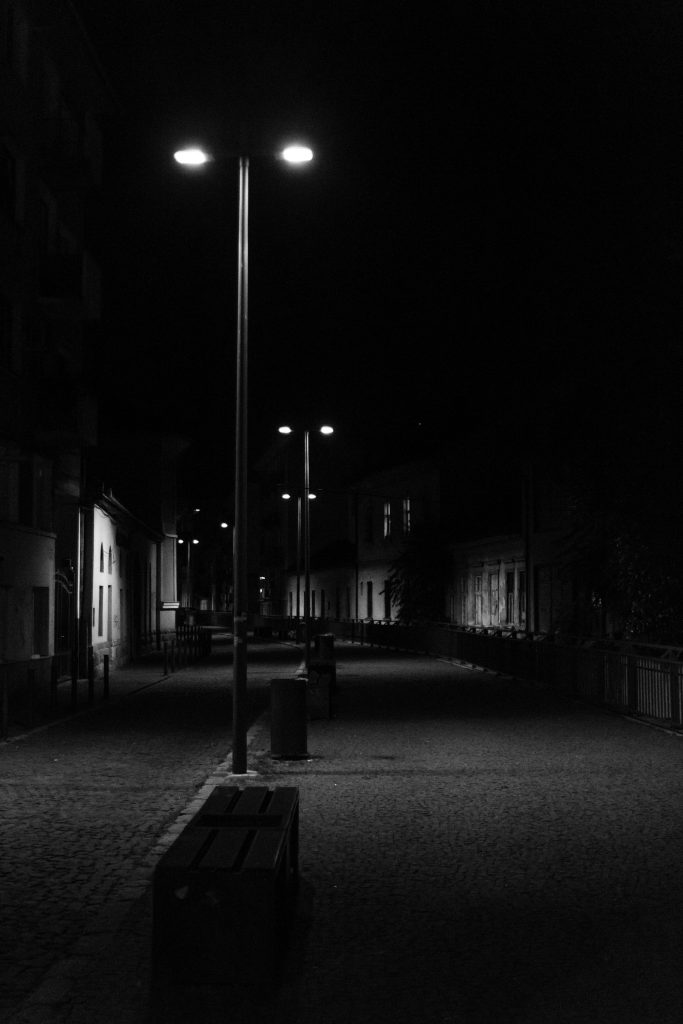
“Why don’t Service officers do these shifts?” asked Cosby. Templeman pondered a reply. “There are two reasons Micky; the first is the official one, the second the unofficial one. The official reason is that Secret Service officers do not have a power of arrest, they hold no police warrant and can take no one into custody.” Cosby nodded in the dark recess of the car’s cabin. “The unofficial reason is that night shifts play havoc with attending cocktail parties.”
Cosby laughed. “Yeah. Who’d want to be out on the streets of London at this time apart from coppers, burglars, pimps and tarts.”
“You forgot milkmen, Micky.”
“Next time I see a milkman guv I’ll say I was sorry.”
They sat in silence; the street was deserted. Somewhere, perhaps it had been a line in a popular song, there was a refrain that London had a special quality at night. But as Templeman surveyed the road, all he saw were piles of dead leaves, that clogged the kerbs, or were occasionally stirred when the wind gusted, and the glittering litter of parked cars. At the far end of the street a figure appeared and walked slowly in their direction. Templeman checked his watch, it was a quarter past three. The man was muffled against the cold and wore a long overcoat; he carried what appeared to be a physician’s bag. They watched him as he came on, and instinctively hunkered down a little in their seats to avoid detection. Templeman counted off the distance from the figure to the front gate of the house in which Depardon was waiting, a drab pile with peeling stucco, that had been divided up from an Edwardian family home on four floors into several smaller apartments. As the figure neared the front gate, he, at first imperceptibly, slowed and drifted across the pavement toward the low walls and hedges that marked out the boundary between the pavement and the houses. It was the gesture of a man who was accustomed to travelling without being noticed. There was something in the figure’s gait, a precise shuffle, that provoked a distant memory in Templeman, from days spent in uniform.
“Micky!” he hissed without taking his eyes from the figure, “Hand me the field glasses!” Cosby reached down to the door pocket and retrieved a set of Army surplus Zeiss binoculars, in spite of the rubber armouring, their shafts still stingingly cold. For a second, the figure eluded Templeman’s gaze, then under the light from a streetlamp his face burst into view, as an actor will step forward on a stage into a pool of harsh illumination from a top light.
“Stinker!” said Templeman.
“Guv?”
“I know him! Let’s wait until he turns into the front garden, he’s the person Depardon is waiting for.”
“Are you sure?”
“Bet on it! Stinker Hughes, he’s a career burglar, not too bright, has a season ticket for the Scrubbs.”
The figure slowed again, and turned in at the gate, a long line of worn flagstones linking the street to a flight of steps up to the front door. As his form disappeared, Templeman and Cosby threw open the doors of the Zodiac and ran toward the house. Hughes had reached the flight of steps, as the policemen entered the gate.
“Hughes!” barked Templeman, “Edward Hughes! Police!” Hughes froze, the doctor’s bag silhouetted against his body. “Don’t even think of throwing that bag away Hughes!” Hughes turned around, his face in shadow.
“I’ve done nothing wrong!” he cried in a faltering voice.
“What’s in the bag Hughes?” asked Templeman, as he drew level, Cosby positioning himself behind Hughes to prevent him getting to the front door of the house.
“My stuff.”
Templeman swept the bag out of Hughes’ grip, while Cosby placed his free arm in a powerful lock.
“What’s this Stinker?” retorted Templeman, “A doctor’s bag? What kind of house call are you making at three in the morning?”
“I…I was going to see a friend. I am returning some things.”
Templeman shook the bag, a muffled metallic sound emerged.
“You don’t have any friends. What’s in the bag Stinker?”
“Don’t call me Stinker,” said Hughes reprovingly, “I’ve changed my ways.”
“Come off it, Stinker, you and a bar of soap have as close a relationship as a priest and condom machine. Last time of asking.”
Hughes said nothing; Templeman took a step back, to gain light from a streetlamp, and opened the bag. Several pieces of gold jewellery and a diamond necklace shimmered in the dark musty leather cave.
“So, Stinker, you were returning some things to a friend. Does your friend live in this house?”
“Yes.”
“What’s his name?”
“Don’t know.”
“Do all your friends prefer to be anonymous?”
Hughes remained silent. Templeman walked up the flight of steps and held a finger against the panel of doorbell buttons.
“Mickey, get him up here,” and Cosby pushed and dragged Hughes toward the front door.
“Now Stinker. There are eight flats in this house, all occupied. If I push the wrong door button, at three o’clock in the morning, I am likely to make someone very angry. Do you know the right button?” Hughes shook his head. Templeman allowed his finger to linger over the button for No. 5, Hughes looked alarmed, then Templeman moved his fingertip to the button for No. 4 and pressed.
The hall light blinked on, a stale aroma already seeping under the door sill before a figure of a short fat man emerged from the staircase. The door opened, and Auguste Depardon stood defiantly on the threshold.
“What is the meaning of this?” he said angrily, as he surveyed Hughes and the two policemen.
“Sorry for the inconvenience sir,” replied Templeman, “although I see that you are still dressed. We are police officers, we wondered if we could have a word with you about the contents of this bag?”
Copyright © David Alexander 2023