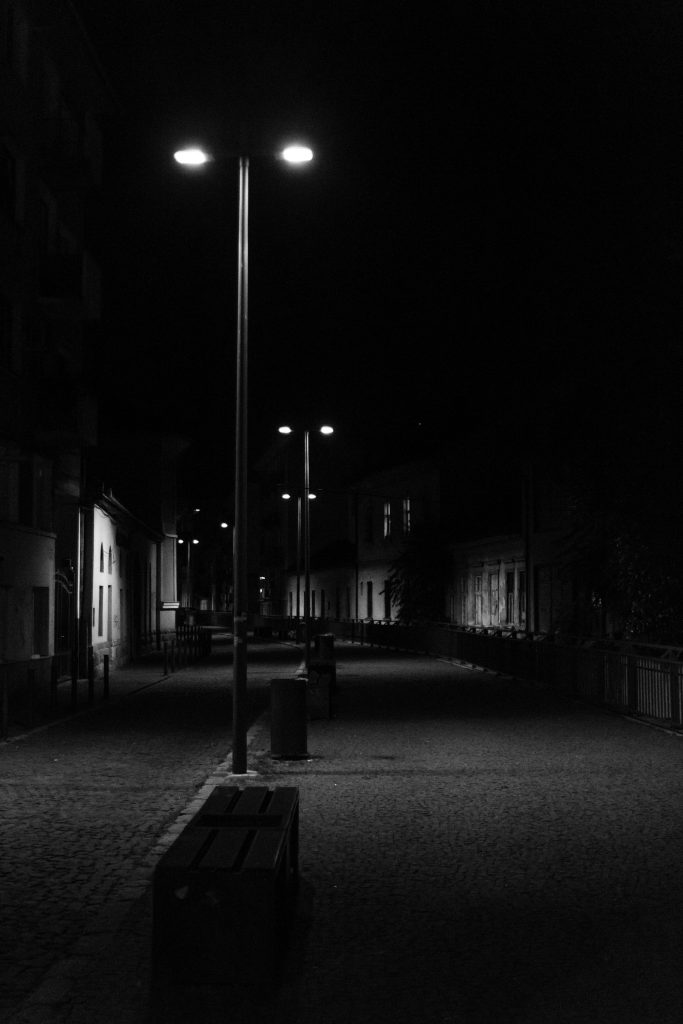
Templeman yawned, his breath rapidly condensing in the darkened cabin of the Ford Zodiac as warm and cold collided. He was tired and his limbs were numb: sleep beckoned; it was the animal response to the wintry night. He considered the bonnet of the car, where a sheet of frost had formed as the vehicle had cooled. The frost sparkled like a thousand small stars: they would shape his dreams. He had to stay awake. He reached behind from the driver’s seat of the car, the proud property of Micky Cosby, and now an uncomfortable observation post for police work; and in the darkness fumbled for the coffee flask which he knew lingered somewhere.
His fingers glanced at the container; it was adorned in a garish red tartan pattern, its surface scratched and dented from many nights of surveillance duty. His mind could make no connection between the flask’s colour and its function. He grasped at it, it disobligingly rolled away and toppled into the footwell. “Oh bollocks!” he rasped, as the flask became lodged where his arm could not reach. Accepting the petulance of his outburst and being disinclined to leave the vehicle and open the rear door, he thrust his hands deeper into the pockets of his sheepskin coat and hugged himself for warmth while holding his muscles tight, a trick he had learned on nights of frozen guard duty while stationed with the British Army in Germany, keeping the British Zone safe.
There was a knuckle rap on window of the passenger door: it was Cosby, returning from a patrol of the neighbouring streets. “Before you get in, Micky,” Templeman said, “the coffee flask has dropped out of sight.” Cosby disappeared, a rear door opened, allowing a gust of piercing cold air into the cabin. Templeman blew another plume of condensing air out of his mouth, besmirching the windshield. Cosby returned, flask in hand, and held it out like a late Christmas present. “Take a cup yourself,” Templeman said, “leave enough for three mouthfuls for me.” Cosby complied.
“Any movement?”
“No guv, the lights remain on at the back of the house. I saw a silhouette at the blinds on the first floor.”
“Then what’s our man up to?”
“Perhaps he is waiting for a woman?” asked Cosby, handing the flask across, then wiping his mouth on the back of one hand. Templeman contemplated the response as he held the cup to his lips. Illicit sex would be the obvious explanation why their quarry, an official at the Belgian embassy in London, by the name of Auguste Depardon, a specialist in economic development, had rented a room at the house on the White City side of Notting Hill. However, the Service would not be interested in his movements if he just maintained a mistress: infidelity was of no concern unless it gave rise to an opportunity for blackmail by a hostile power. There were times when Templeman wondered what sex lives those employed by the Service enjoyed, if indeed the idea of pleasure without pain entered their collective consciousness. He made a mental note to read up on Freud, in case Freud had ever analysed someone who worked at MI5.
On this occasion McCreadie had been insistent that the undisclosed concerns of the Service had to be acted on. Templeman emptied the contents of the cup, screwed it back onto the flask, which he then thrust down between his thighs, and reached into a pocket of his coat. He retrieved a surveillance photograph of Depardon; the Belgian was short, chubby, with a thin moustache and receding hair. He could not imagine why a woman would want to venture out on a freezing night for a sexual tryst with a man who looked like a fat aging Charlie Chaplin, unless she was being paid.
“It has to be more than sex, or else neither McCreadie nor the Service would be interested.”
“Did the super say anything more?”
“Micky, you know how knowledge flows in the Branch. The Service tells Superintendent McCreadie what he needs to know, McCreadie then tells me what I need to know,” and Templeman paused, “and I tell you nothing.” They exchanged short laughter, to acknowledge the truth and falsehood of Templeman’s joke. “Our little fat Belgian has been up to something. His account at Martins Bank shows no unusual activity, he writes between five and ten cheques a month, nothing untoward. He lives apparently modestly, has a wife, but no children. However, he buys suits from Saville Row, and pays cash for each garment, but he never cashes a cheque on the Martins Bank account for the money.”
“An undisclosed income.”
“A very considerable undisclosed income.”
“My cousin Chloe worked at Martins Bank.”
“Did she enjoy working there?”
“She had to leave. She got married, it was their policy.”
Templeman could only guess at why the Service had grounds for believing that Depardon was a spy. Templeman rarely spoke to his Department’s Service contact, this activity being reserved for McCreadie. He tapped the photograph on the steering wheel: still the truth eluded him. Special Branch had placed Depardon under surveillance four weeks earlier; surveillance work was demanding, doubly so in the dying winter days before spring had dared to suggest itself. The money Depardon freely spent on clothes was the clue to his extracurricular activities. They had watched as he left for work each morning, followed him at lunchtime, photographed everyone he had contact with. The previous week a female office had followed Depardon’s wife as she went shopping, lingering over the brassiere counter in Selfridge’s department store, while Mme Depardon tried on a new winter coat. Neither Auguste Depardon nor Mme Depardon had met anyone known to the Service or the Branch. Templeman looked across the street to a London plane tree which stood in a square of ruptured tarmac; in the winter gusts it waved its denuded branches forlornly in the aura of a yellow sodium streetlight.
Copyright © David Alexander 2023
Photo by Vlad Bagacian on Pexels.com