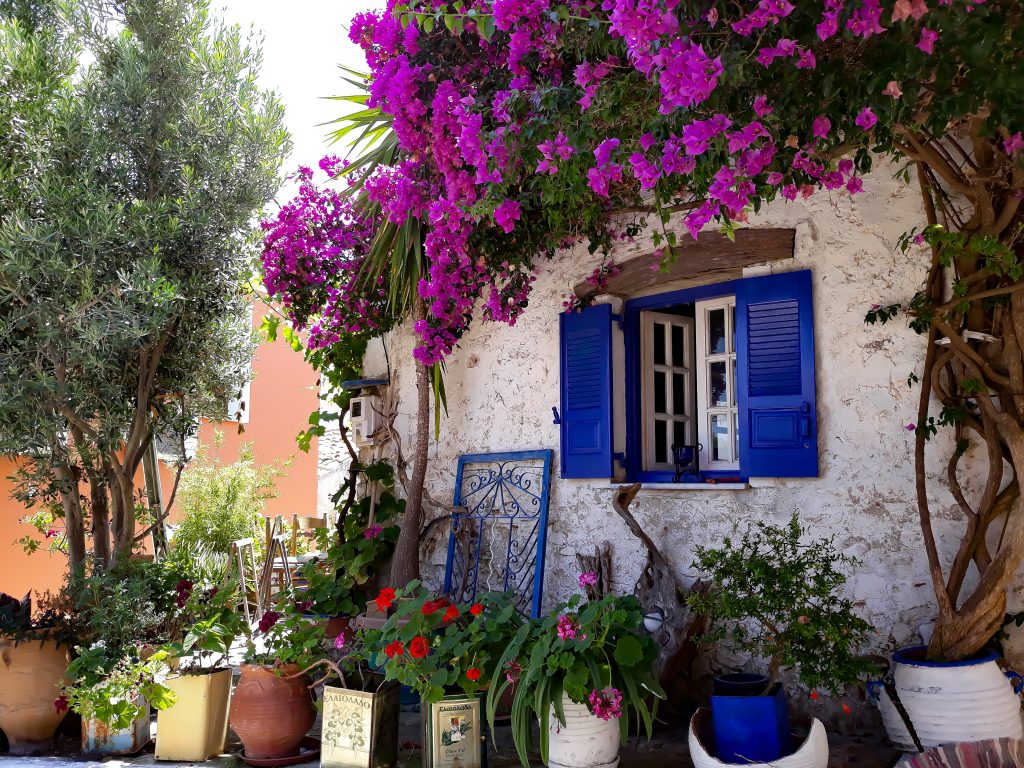
I had been told very little by my agent about Ms Clements, and I do not like meeting people about whom I know little. But more troubling was the disturbance to my peace after 5 years on Corfu.
“But why?” I had asked over the telephone.
“They are running a story on writers in exile…”
“Oh God! That makes me sound like a fugitive,” I had retorted, as I watched a ferry clear the headland, its occupants, a consignment of expectant tourists and inattentive locals, as ignorant of my existence as I was of theirs.
“Just co-operate Michael, you need the sales.”
As I replaced the receiver I visualised my agent, Louise, as she gulped coffee and pressed the speed dialler to talk to her next victim, perhaps a commissioning editor desperate to find a new Joanna Trollope. I walked into the garden, kicked off my shoes, taking care to avoid dropping a barrage of worn leather on Lord Bryon, my most faithful and oldest cat, and sat dejected, facing the sea. I warmed to my role as the condemned man; incongruously rubbing my toes in the cropped grass while imagining that I was posing for Caravaggio, a piece entitled speculatively ‘St Paul contemplates the journey to Rome’. My sense of virtuous martyrdom evaporated when I remembered that St Paul had been shipwrecked on Malta not Corfu, and that he was as eager to engage with the world, as I was to avoid it. The olive grove which abutted my property to the west shimmered in the rising heat, the lemon trees in my garden heavy with lustrous fruit. As someone once said in a not very good film, ‘Oh God! Not another fucking beautiful day!’
The sun that rose over my house, and shone through its deep windows, filling its being with warmth and light in a relentless cycle, also shone over Louise’s luxury flat, and for all I knew that of Ms Clements, but it was different here. It had to be. Perhaps she, Ms Clements, lived in an undesirable part of London, both dreary and expensive, like one of the numberless and cluttered streets of Victorian terraces which radiated out from Shepherds Bush, conveniently located for drinking Turkish coffee at a café while reading The Guardian, but utterly, utterly, garish. The sun that rose over Corfu promised days that wound down, and nights that mysteriously rewound, before repeating the cycle the next morning, like an un clock-like clockwork: there was no discernible mechanism in the heavens.
“Ms Clements, how do you do?” I lied, as a pert (dyed) blonde young woman presented herself fresh from the taxi. The driver removed a piece of luggage from the boot, and the vehicle, an old, battered Mercedes, departed in a plume of warm soot. Her luggage, a blue suitcase with a dented corner, was the visible sign that she was not only my interrogator but my guest: there was no return flight until lunchtime the following day. She surveyed the terrace before answering.
“Very well, thank you, Michael. And please, call me Rachel!”
“I will.”
“Do you own all this?” she enquired, in a gushing tone as if space, light and order were seemingly alien concepts; and I fleetingly wondered if Louise had sent an estate agent in place of a journalist.
“Yes, I bought the house in the early eighties, but the rest of the land only became available a few years ago.”
“Is that when you decided to live here permanently?”
“Yes. It is my sanctuary. Welcome.”
She turned her gaze to the horizon, her eyes betraying incomprehension at the rugged beauty of my Grecian backyard.
We walked through the garden to the pergola, its timbers overgrown with vines, which my housekeeper, Sofia, had arranged for lunch. The view from there, through the olive trees to the sea, was uninterrupted. Sofia had prepared her speciality, a salad with grilled snapper on a bed of succulent tomatoes and crushed olives, their silvery torsos grilled lightly, and basted with a secret recipe involving olive oil and spices, their gritty flavour oozing through the warm air. There were in addition two woven baskets: one of fresh Greek bread, which lay in heavy and crisp folds, and the other a basket of juicy, plump figs, their fat ends resembling hardened dark nipples, harvested from her garden. Herodotus believed that figs were as old as humanity, in which case, our ancestors were indeed blessed.
Copyright © David Alexander 2023
Photo by Bert Bohemian on Unsplash