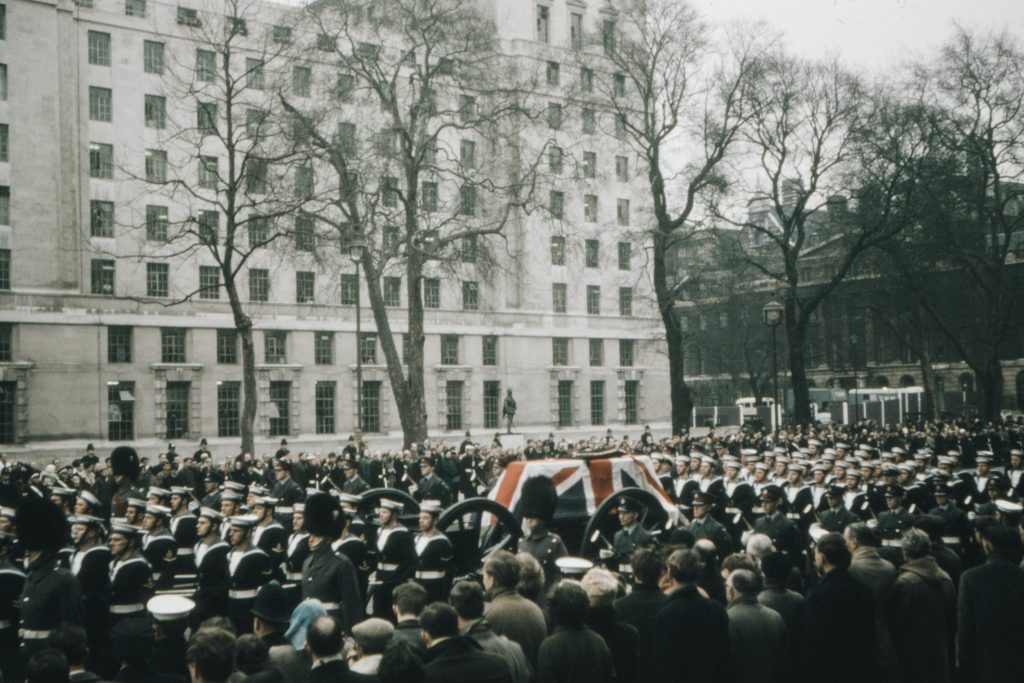
A man who looked like Adam Faith, but wasn’t, in the fashion of the day, turned to look left along Fleet Street. Templeman stiffened as the man, around twenty-five years of age, blond hair, neatly cropped and swept back away from his forehead, sheepskin jacket over a dark suit, white shirt and plain tie, strained to see the traffic. Templeman’s fingertips instinctively sought out the leather strop on the truncheon in his concealed pocket. The young man seemed keen to get a clear view along the road, in spite of being situated three rows back from the nearest constable. The gun carriage carrying Churchill’s body would not reach this spot for thirty minutes. Why crane his head now? The young man was alone, that was not a good sign. Templeman knew the order of the official limousines which were sweeping along Fleet Street towards St Pauls Cathedral. Templeman calculated that it must now be 9.52 or at latest 9.54; he applied the time to the schedule, a slew of ambassadorial names from former colonies slipped past his mind’s eye. None were significant enough, what would an assassin gain? Nothing, unless such an outage was a diversion for a larger target. As Templeman breathed, great wreaths of cooling air escaped from his lungs. He surmised that the two Branch detective sergeants who were assigned to this section of the route were too distant to render immediate assistance. If this young man’s suspicious actions were the herald of violence, Templeman would have to rely on the uniformed constables, and in extremis, the sailors standing rigidly to attention. The young man’s glance shifted to the crowd to his left, away from the road, and he spoke to someone. Templeman was too far away to hear what he was saying, but the young man’s intense gaze faded, and a smile broke out on his lips. Templeman’s own gaze shifted quickly, to find the object. A young female form, her back to Templeman, came in to view, the head partially shrouded in a blue silk scarf. The young woman stepped forward, leaned in, took the young man’s left arm and squeezed it. The smile on the young man’s face was broader now, and with his free hand, he caressed the head and shoulder of the young woman. Templeman breathed out slowly, the lovers had been reunited.
The procession came on, the massed bands playing the funeral march, mounted detachments, marines, RAF regiment, dignitaries. The relentless pounding of the feet of two hundred tethered sailors, mechanical, metallic, rose up and wafted into the cold morning air. Templeman stamped his feet to get some circulation; his long wait, his long vigil, nearly over; a uniformed constable stood to attention and saluted as the gun carriage passed. He must have served, thought Templeman; history was sliding by. McCreadie had allocated this stretch of pavement to Templeman, as the most likely area that an assassin or demonstrator would select, given the ease of breaking through to the road. He ruefully considered the need for alertness and speed, to overpower and drag away an assailant, search for concealed weapons. Templeman looked to his right, and the far away gantry which held an outside broadcast television crew, its relentless monochromatic eye transmitting grainy images into houses across the land. ‘Just my luck’, he thought, ‘to catch some bastard, an agitator out for revenge, and be recognised.’ The Branch did not enjoy publicity, Templeman at that moment regretted his decision not to wear a wide brimmed hat that morning. The gun carriage passed on, the rest of the procession, horse drawn carriages for close family, passed on. Templeman felt tension dissipate from his body. He sensed that the crowd was already stirring, the performance of the state circus had concluded.
As Templeman made his way to The Strand, he saw Cosby approaching him. Cosby was one of the Branch detective sergeants who had been assigned along with Templeman. Like him, he had been a National Serviceman, fought in Malaya, got malaria, been given a medical discharge. He was a jaunty lad from a council estate in Peckham; he had become a policeman as the other options for jaunty lads from council estates were not too promising.
“Morning guvnor,” said Cosby, his face as expectant as a puppy’s.
“Morning Micky, what do you think of the funeral?”
“I was expecting more flowers,” he replied, his face creasing into a broad grin. “When my nan died, the street bought all the flowers in Holland, couldn’t move for flowers.”
This, by Cosby’s standards, was an understatement. Templeman believed that ‘Embellishment’ should have been his middle name, not Wayne. Cosby was the butt of some joking in the squad room, on account that his parents had given him the name due to his father’s admiration for the actor John Wayne; as a consequence, Cosby’s nickname in the squad was ‘Cowboy’, ‘Cowboy Cosby’ had a ring to it, Templeman did not deny that.
“Any public order offences noted?”
“Nothing that the wooden tops can’t handle guvnor. I saw one drunk and disorderly, but I think the bloke was genuinely sad at the old boy’s passing and had drowned his sorrows.”
“Drinking on a Saturday morning, with the pubs closed. Shameful. Let the wooden tops deal with him.”
Cosby nodded enthusiastically and fell in to walking beside Templeman as they made their way toward The Strand through the dispersing crowd.
The squad room at West End Central police station was crowded; at the far end, a television had been deposited on top of a filing cabinet. Several detectives sat and watched or stood, lounging against the filing cabinets that ran along one wall; their combined attention was taken with Churchill’s funeral service broadcast live from St Paul’s Cathedral. Some turned briefly to acknowledge Templeman’s arrival: a short, muted chorus of ‘Guvnor’ rang out in the room. One man of stocky build, with thick greying hair, turned around in his seat and nodded toward Templeman. “All in order John?” he asked. “Yes Frank,” Templeman replied as he took a vacant seat. The other man nodded again and turned back. Templeman had noted alcohol on the man’s breath, and his bloodshot eyes. Inspector Frank Markham remained a good policeman in spite of his need for alcohol; older by fifteen years, he was on his way to retirement, if only his liver lasted that long. As if an afterthought, he said over his shoulder “What are McCreadie’s orders for you for the rest of the day?” Templeman cleared his throat, he hoped that he wasn’t developing a cold as a consequence of exposure to the bitter London air.
“Once the service has concluded, relieve the primary protection team for Sparrow.”
“I always thought that was a strange cover identity, for a foreign government minister.”
“It wasn’t my idea, blame the Foreign Office. A deficit in imagination is required if you want to be one of their sandwich munchers.”
They exchanged laughter infused with years of other people’s lack of imagination.
“Where’s he staying?”
“The Dorchester.”
Markham turned around.
“The Dorchester?” I’m impressed, our little birdie friend has good taste.”
“His government is paying.”
“A night at The Dorchester though John, you might get lucky.”
“I might also get a nasty little disease from one of the tarts that frequent the place.”
Markham guffawed.
“It’s all part of the fun of keeping a VIP bullet free.”
“Thanks,” said Templeman, “but I’d rather not.”
“Just as well, I think promotion boards these days look unkindly on that type of behaviour.”
“I hope so,” replied Templeman, emphasising hope.
As their exchange concluded, attention swung toward the television; the Archbishop of Canterbury gave the blessing, the waiting guardsmen, shielded from the outer cold by their greatcoats, moved forward to take up the coffin once more.
“Micky.”
“Yes guvnor,” replied Cosby from his vantage place at the back of the squad room, a cup of instant coffee in one hand.
“Get the driver, we’re due at The Dorchester.”
“Try not to shoot anyone,” said Markham.
Copyright © David Alexander 2023