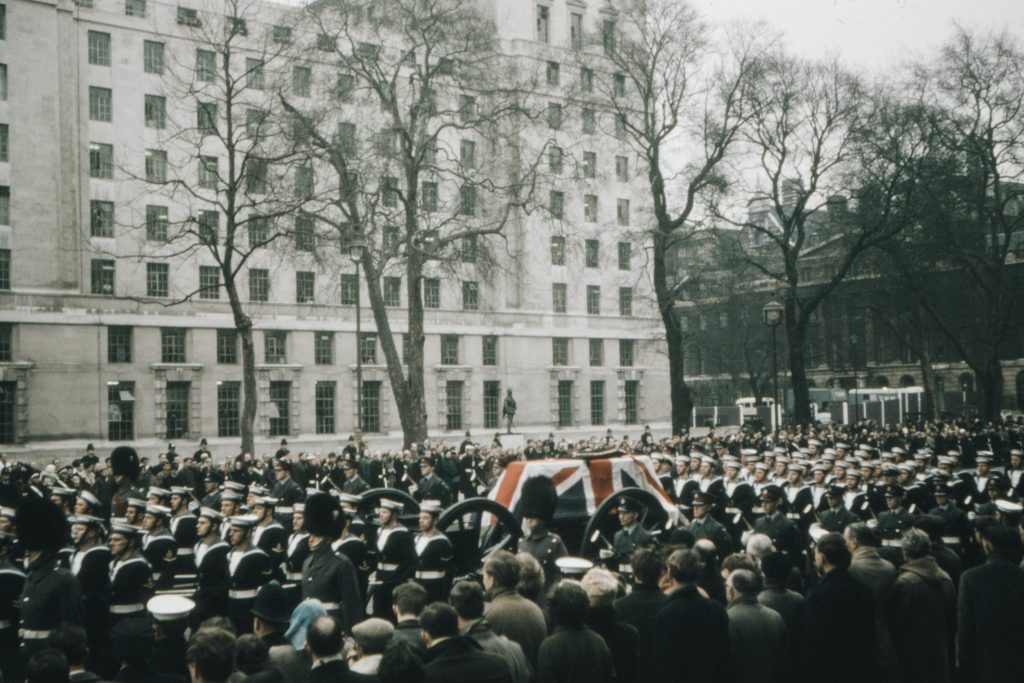
A cold silence had fallen across the city. It was as if 7 million people were holding their breath; it was a pensive silence, an expectation, but no one knew for sure of what. In Fleet Street the crowds were a little thinner than at other locations; but all pressed forward for a glimpse, all wrapped and shod against the cold of a January day, almost the last day of January 1965. John Templeman chose his place across from the junction with Chancery Lane. Dressed in a grey worsted suit and navy-blue overcoat, white shirt and green knitted tie, he affected no hat, in spite of the cold. The wind dragged icy razor blades over his exposed features, stinging his clean-shaven chin.
He kept his hands in his pockets; beneath the fingertips of his right hand, he felt the tip of the truncheon. Today, as the newspapers said the inevitable day, there should be no trouble. The man the crowds had come to see had evaded a marksman’s bullet. The gangsters of South London would crowd around television sets in dingy pubs or the living rooms of terraced houses, and weep. But they were no longer his concern, he had moved on. Today was the inevitable day, the day that Churchill’s body would be carried in procession through London on a gun carriage; through the grey cold streets; past the faces of citizen and visitor. This was the day the newspapers said that people would tell their grandchildren about.
Crook and thief taker, baker and bus driver, old foes, old friends, all agreed: nothing would spoil this day. But just to make sure, to protect the Prime Ministers, Presidents, Kings, Princes and Queens gathered in January in London, Special Branch would keep watch. Det. Insp. John Templeman would keep watch. He withdrew his left hand from the comparative warmth of the overcoat pocket and checked the time: 9.37; the events of the official day would unwind from 9.45, in eight minutes. The procession from Westminster was about to begin, thousands of soldiers, sailors, airmen on parade. Each one aware of the burden of the day; each one drilled. A State funeral, the funeral of the greatest Englishman, but to just to make sure Special Branch would keep watch.
In front and to the left of Templeman uniformed constables stood at the pavement’s edge. In front and to the right of Templeman was an Army cadet and a St John’s Ambulance volunteer. Beyond them all, lining both sides of the road, sailors were standing to attention, rifles presented, their white caps and white gaiters as inadequate winter camouflage in the deep blue of their uniforms. They kept their eyes on the road, while the constables surveyed the people on the pavements. So did Templeman; he looked left along Fleet Street to Temple Bar and the Law Courts. People were huddled in near silent clusters; they spoke in low whispers among themselves, breath curling away in the grey morning light. The newspapers said that people would come out onto the streets overnight to get the best view of the procession. Templeman had paid his respects along with the 320,000 others that had visited Westminster Hall. He was too young to have fought in Churchill’s war; he had to content himself with being a National Serviceman, and Suez. He looked at his watch again: 9.45, at that moment in Westminster, Churchill’s body would be brought to the gun carriage, to start the procession, and a phalanx of sailors would step forward in unison to draw it through the streets.
It had come as no surprise that all police leave had been cancelled, but Templeman wondered whether an assassin would choose today, the inevitable day for Churchill, to attack one of the world’s representatives. De Gaulle of France would go to St Paul’s; Konev, the commander of the Soviet Union’s forces in East Germany, would be present, and U Thant, the Secretary General of the United Nations. Templeman wondered what type of assassin would choose this day. Dissident Frenchmen, angry at the loss of Algeria, imperial pride struggling against their sense of the French masculine? Or perhaps a German provocateur, keen for Berlin’s liberation, at the expense of its reduction to a pile of radioactive dust? That left U Thant. Who would want to kill U Thant, the mild Burmese diplomat and emerging global stateman? A Soviet agent, in reprisal for Cuba? A Congolese agent, in reprisal for Operation Grandslam? The cold gnawed at Templeman’s face; as Superintendent McCreadie was fond of saying, police work required application in adversity. Templeman supposed that ‘McCreadism’, as he was given to categorizing these outbursts, was one of the first fruits of the police college that McCreadie prided himself on attending. He should try standing for three hours on the frozen corner of a street in London in January. Unless of course, the aphorism had come to McCreadie pounding the beat in his native Glasgow.
Copyright © David Alexander 2023